Entrepreneurship
A Seat At The Table
Reflections on contribution, expectations, gratitude, fear and faith.
What Are You Bringing to the Table?
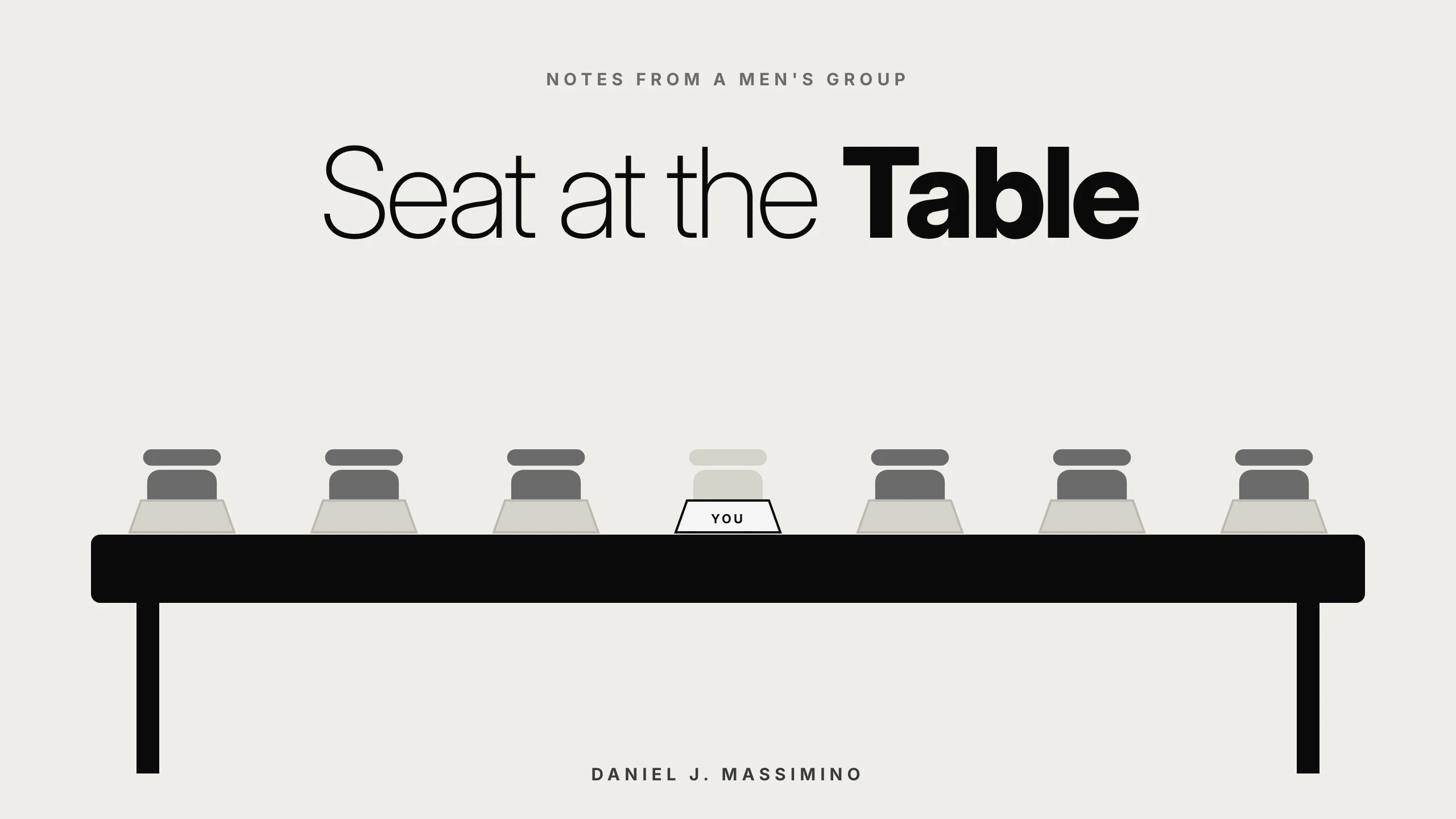
I've been joining a small men's group on Monday mornings. This week it was a smaller crowd. Veterans Day was the next day, and our usual host had a lot going on. We were spread from Pittsburgh down to Texas. One of the guys mentioned Pittsburgh is having a decent football season this year. Are we? I don't know. I don't pay attention.
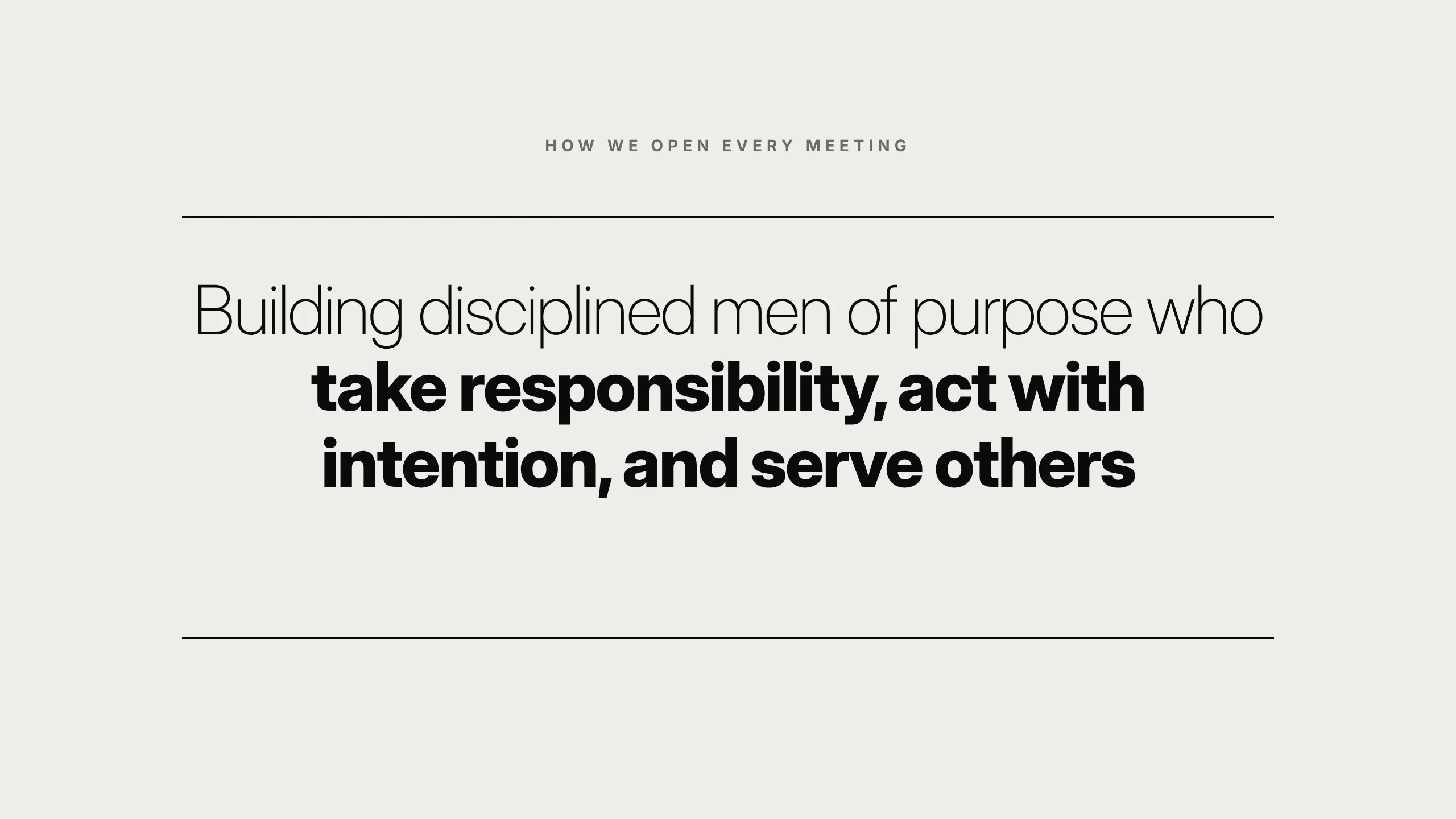
We open by reading a purpose statement together: building disciplined men of purpose who take responsibility, act with intention, and serve others. Then we pick one idea and pull it apart.
This week's idea came from Napoleon Hill. The facilitator blended two of his principles, going the extra mile and personal initiative, into one question: what value do I bring to the table? To my personal relationships, my business relationships, my customers, and to the world. That could be anything, from money to volunteering time to contributing in some way.
His point was that one of the biggest sources of pain for men is expectations. We expect things from life, from people, from our loved ones. But are those expectations based on what we're bringing to the table? Or is it just because we grew up in a family where people did things for each other, so that's our programming? And when you do something good for somebody, most times it doesn't come back from that person. Whatever you get back comes from somewhere else.
Another member said he loved the idea of basing it on what you bring instead of what you expect. Hold yourself to a standard, have the heart of a servant, and get the joy out of the service itself. He admitted that for a long time it was giving with the expectation of getting, and he's still growing out of it.
The facilitator shared that he used to be very selfish growing up. It was always "what's in it for me." Life didn't treat him great for a while, and at some point he knew he needed to change. The easiest way he could understand was to go out and serve: help people move things, talk to them, tiny things you don't even recognize as helping. Little by little, everything started changing.
That's where I chimed in.
Is karma real?
If you look at karma from a first principles perspective, which is drilling down to the fundamental truth of something, and you go back to when the universe started, it was at zero. A plus one and a minus one. So is karma real, or is it just our imagination? Because I know a lot of really bad people that nothing bad happens to. And I know a lot of good people that a lot of bad things happen to.
Take a two-year-old born into a home surrounded by drugs and crime, with a dad who might not even be alive. Because of that, that's all that kid knows. What did he do to deserve that? Where's the karma for that kid?
One answer in the group was that this life is temporary. We come from somewhere and we're going somewhere, and somehow, at some point, a kid like that gets the opportunity to get out. Another was that we don't know how anyone's story ends. Bad people might have great things happen to them, but can they sleep at night?
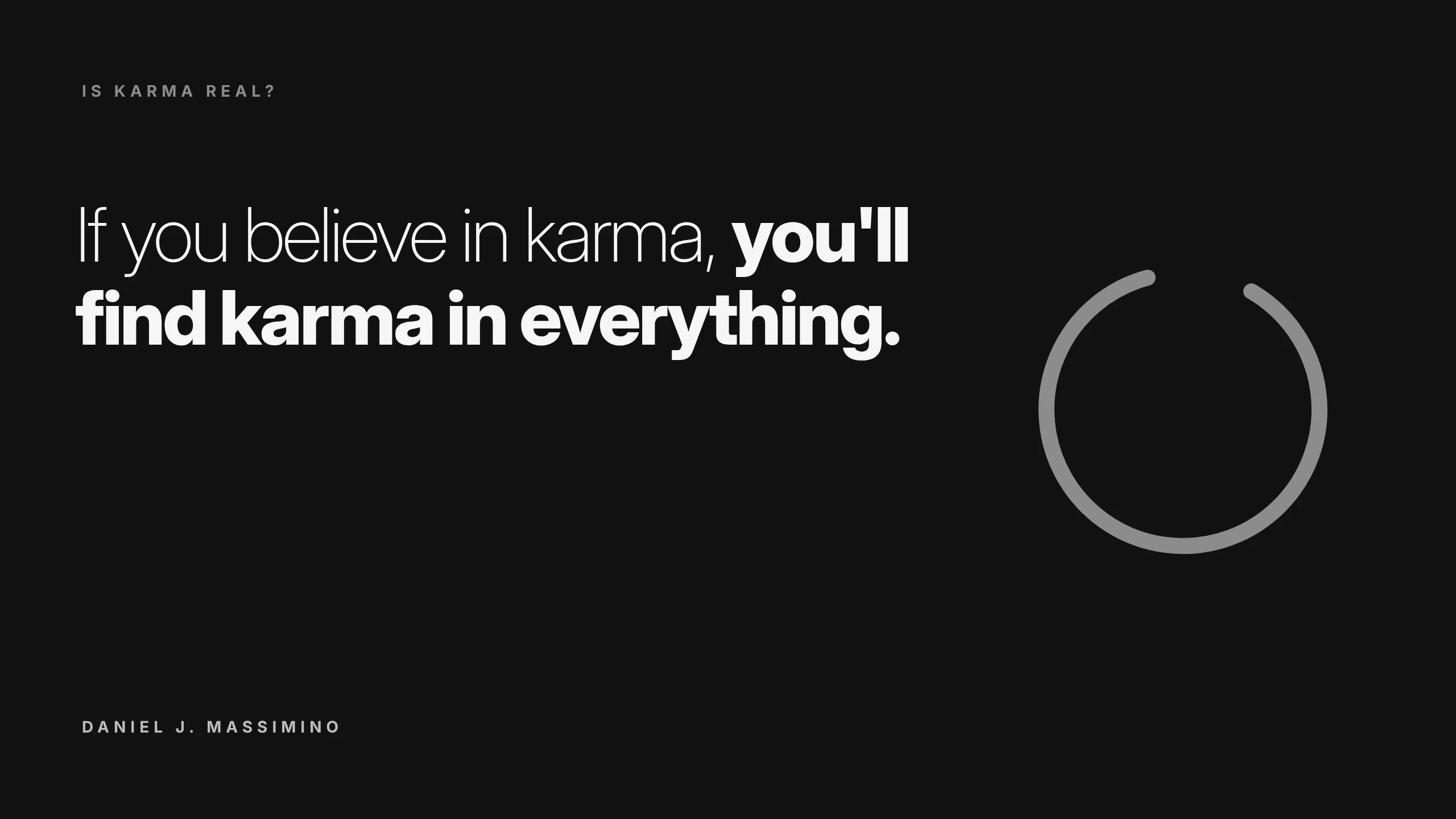
The other thought I had: could it be that what we believe is what happens? In other words, if you believe in karma, you'll find karma in everything. The group mostly agreed. That's close to Napoleon Hill's whole idea, that we become what we think about most of the time. The facilitator took it further. He believes in the law of attraction, but says it's secondary to the law of vibration. Whatever frequency you're vibrating at, that's what you attract, and you become part of your surroundings.
I brought up Benjamin Franklin. In a letter he wrote to the president of Yale near the end of his life, he laid out what he believed:
"Here is my Creed. I believe in one God, Creator of the Universe. That he governs it by his Providence. That he ought to be worshipped. That the most acceptable Service we render to him is doing good to his other Children. That the soul of Man is immortal, and will be treated with Justice in another Life respecting its Conduct in this. These I take to be the fundamental Principles of all sound Religion, and I regard them as you do, in whatever Sect I meet with them."
Maybe karma doesn't settle up in one lifetime at all.
Is anyone really selfless?
Then I said something I've thought about a lot. At the bottom of it, I still feel like helping people is always derived from a selfishness. Humans are inherently self-preserving. Even if I'm helping people without anything in return, what is my intent? Why am I doing that? I could say I just feel great helping people. But really, it's because it makes me feel good, or it makes me feel whole, or maybe it makes me feel better because I did something wrong and now I'm righting that wrong. At the very nitty-gritty of it.
Nobody really argued. One of the guys said it brings significance. People telling you thank you, even when you're not asking for it. We all have an ego and we need it. It's part of our being. The problem is when we're ego-driven.
Am I a bad person for not saying thank you?
The week before, someone in the group called please, thank you and I'm sorry the magic words. I don't naturally say those things. I feel thankful, but I express my thankfulness through my actions. If I'm thankful for this group, I'll try to show up next week and do something about it. But I might not say thank you. So I asked: am I a bad person for that?
One member, a veteran who went from the military into managing a team of 30 analysts, said he always made a point of saying please and thank you, because he wanted warmth in his management style. Coming from the military, it's easy to just give orders. There's no real question about it. He got thrown into managing civilians right away and had to learn quickly that a little finesse goes a long way. A little honey goes a long way.
Another member, an associate pastor, said we have to understand where people are coming from and what's going on in their world. He's worked with people of all different backgrounds, and he used to take offense when people didn't respond the way he expected. Now he gives people room to be themselves. He quoted 1 Thessalonians about knowing those who labor among you. Understand your audience, and govern yourself accordingly.
Someone asked if I'm just being immature. I am immature. It's okay. Somebody else said maturity is progressive, and that the married guys know their wives make them feel like they don't know how to drive.
For me, I don't care if you don't say thank you. I don't expect it, and I don't get any value out of it. Maybe that's a lack of empathy, but there are different love languages. Everybody loves differently. I didn't even realize how many people care about it, that it's a big deal to them. I can tune it either way. I could be super personal if I want, but my natural state is not that.
The veteran said that after knowing me a few weeks, I have a pleasing personality, so it's almost like I say thank you with my body language. He said he can't get away with it because he looks like a jerk. Coping mechanisms.
When my brain shuts down
Something I have a problem with: I go to a group setting every weekend with a couple hundred people, and my nervous system just shuts down. My brain stops working and I can't really talk to people. People are probably thinking, what's with this jerk, he doesn't even say hi. And I'm thinking, I want to talk to you, but my brain is shutting down. So is there karma behind that? Because I didn't say hi to somebody, now I'm a bad person?
The advice I got: get around settings like that more. The more you do it, the more you'll find yourself engaging. You'll hear a conversation that piques your interest, and human nature takes its course. Another member said the things we avoid always come back. Face the fear head on. We'll screw up the first few attempts, but it's like learning to walk as a kid. We just keep trying without fear, and at the end we can run. Get around people and you find out they bleed red just like everybody else.
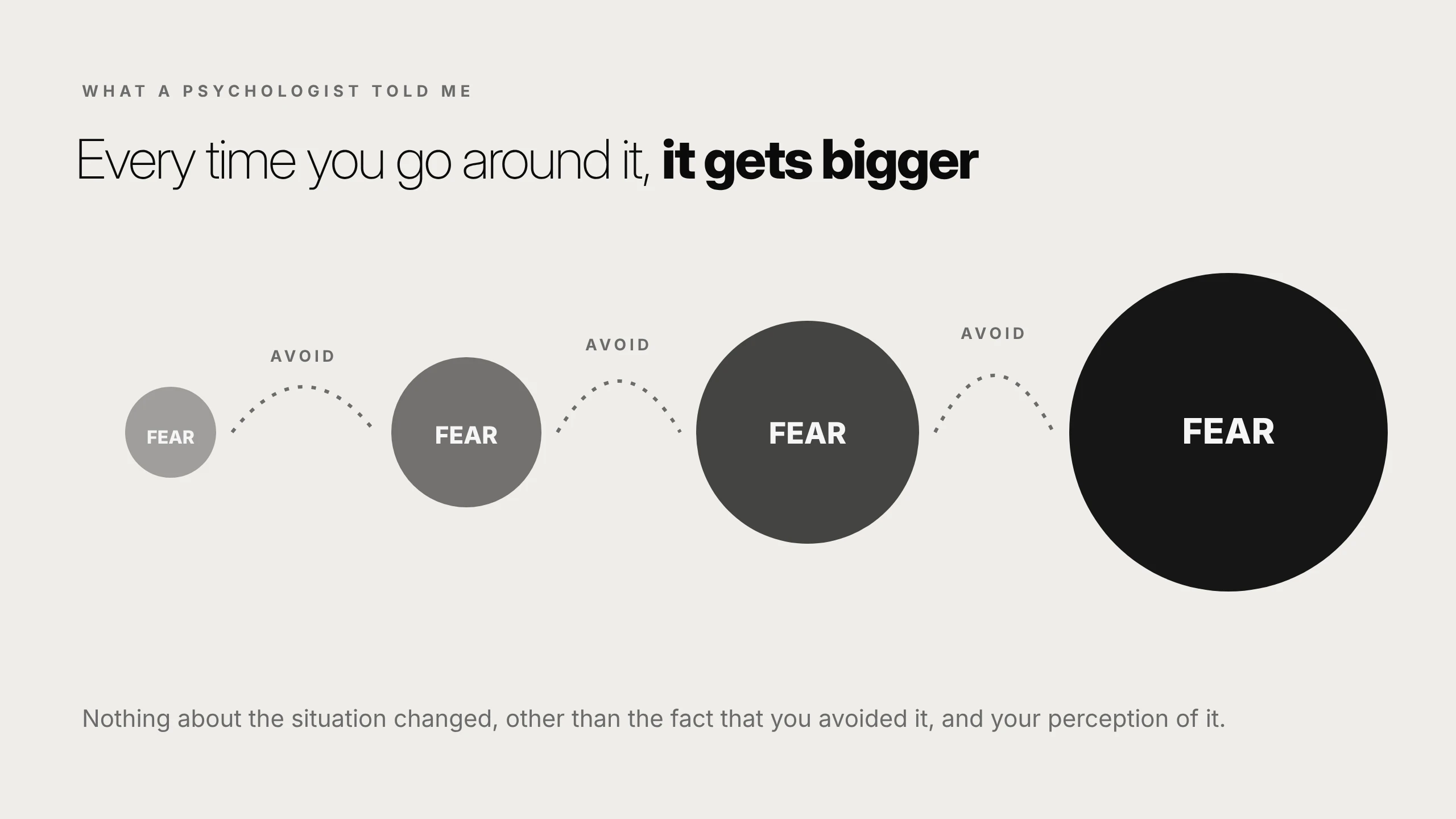
That reminded me of something a psychologist told me, probably the smartest psychologist I've ever met. If you come to a fear and you avoid it, the next time you come to that same fear, it's magnified. If you avoid it again, it gets even bigger. Nothing's changed about the situation, other than the fact that you avoided it, and your perception of it. Once I heard that, I was like, wow, you're right.
The facilitator added two practical things. First, make the decision. Second, control the environment. You don't have to start in a place with 200 people. Start with 30, 40 or 50. It triggers less anxiety and you feel more in control. Growth comes in the uncomfortable, and the conversation you don't want to have is usually the one you should have, whether it's with your partner, your business partner, your employee or your boss. It's usually not as bad as you thought.
The veteran pushed back with one exception: the unwritten gym rule. You don't just walk up to somebody in the middle of their workout. The facilitator's answer was that after you see the same people for a few weeks, they become your gym partners. It's the same reason people don't buy from us. They don't know us and they don't trust us yet. Once they trust you, everything changes.
He believes the deepest fears under most avoidance are the fear of being judged and, most powerful of all, the fear of not being good enough. Not good enough to be loved, to be respected, to receive. I'd add the fear of the unknown. He said that one requires faith.
Six needs
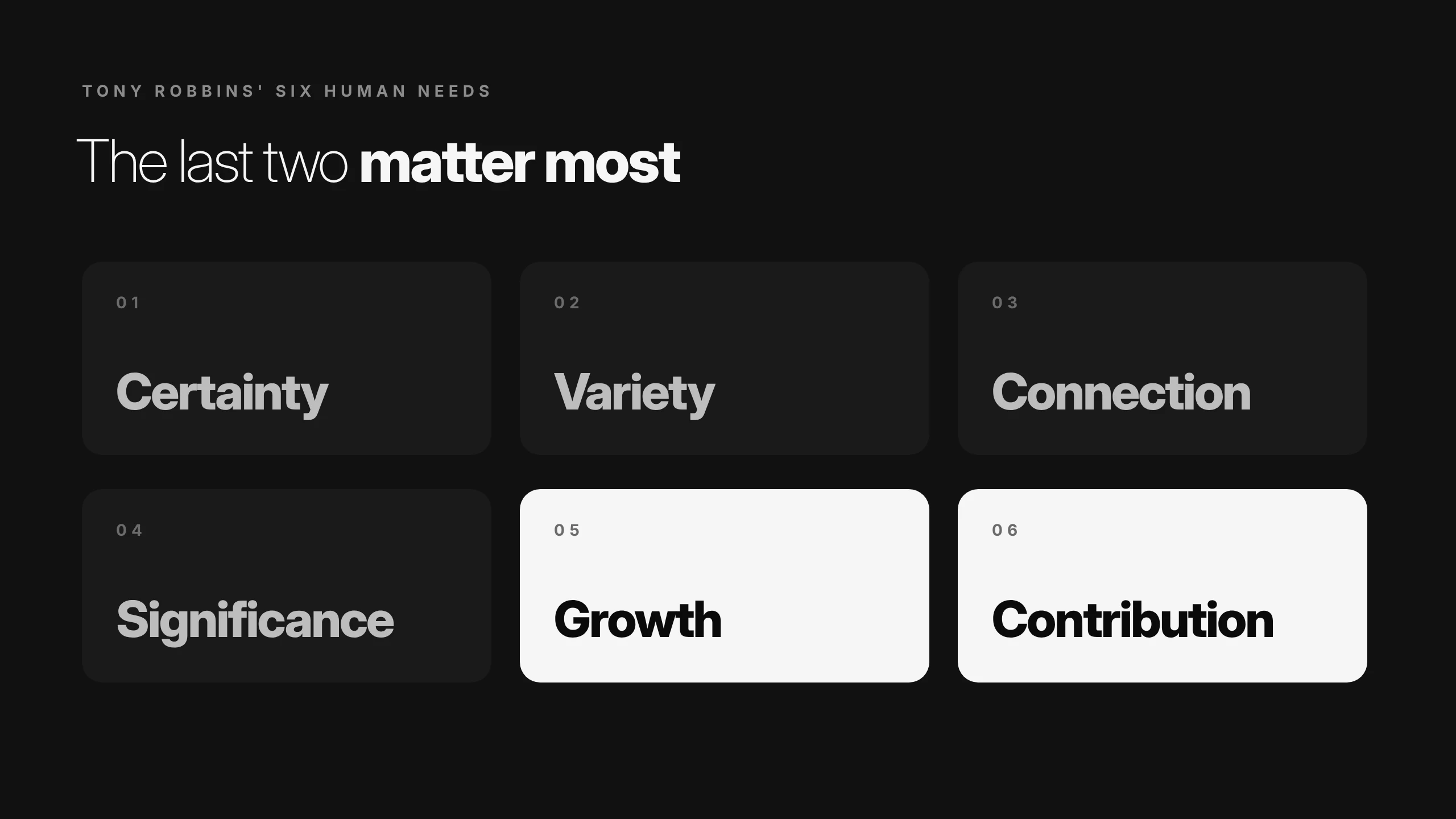
We finished with Tony Robbins' six human needs. One of the guys thought it might go back to Maslow's hierarchy of needs. We said we'd look it up.
The first is certainty. A lot of people don't do things because they want to know if it's going to work. But when you enrolled in school, did you know how it was going to go? The second is uncertainty, or variety. That's why we dress differently, eat different things and go different places. The third is connection, and it's the reason people stay in relationships too long, or take too long to let go of a staff member they know they should fire. The fourth is significance. People wear sunglasses even in the dark. Even the people who say they don't want to stand out, that's their way to stand out.
According to Robbins, when someone meets two of your needs, you gravitate toward them. When they meet three or more, you'll do almost anything for that relationship.
The two most important needs are the last two. Number five is growth. The point that stuck with me was that the most painful time in your life is when you stop growing, usually right after you accomplish something big and suddenly have nothing to push against. Somebody the week before called it needing an enemy. We're all fighters here. We need an opponent, something to conquer. Growth comes from resistance.
Number six is contribution, being part of something bigger than yourself. When you have a great experience at a concert, a restaurant or on a trip, you want to share it. The facilitator said he believes God wants every single one of us to be rich in all senses, in all areas. I agree, 100%. The pastor brought up John 10, "I came that they may have life, and have it more abundantly," and said it's not just money. What good is money if you don't have anybody to share it with?
Common ground
That led to how relationships start. The pastor said lasting relationships almost always start from common ground. School, sports teams, work. He's a few weeks short of 29 years of marriage, and he met his wife at the time clock on her first day of work.
The veteran said that's why he doesn't go to clubs anymore. Alcohol changes the mental state, so you're not really speaking to that person. Liquid courage might start the chemistry, but once everyone's sober, you see who's who. All false positives.
Faith gets tested
Right before we wrapped up, one member said he's been praying for stronger faith, and that faith is supposed to be like love: unconditional. You don't need to see a miracle to have it. The pastor said to brace for it, because your faith is going to be tested whether you pray for it or not. That's part of growth. We can't grow without resistance.
The facilitator closed by saying what he loves about the group is the different perspectives. We all grew up in different environments, at different levels, and that's what makes it better.
If I'm thankful for this group, I'll show up next week and do something about it.
With A Grain Of Salt
Dan
Thank you to all the humans who gave me the courage to write this article.